

28 Oct Brace, brace, brace M’sia for the US presidential election
It is almost one week before election day in the United States, Nov 5. Early voting is underway, with over 20 million votes cast already and counting in an election that is expected to have one of the highest turnouts in history.
All eyes are on the seven swing states that are seen to determine the outcome: Arizona, Georgia, Michigan, Nevada, North Carolina, Pennsylvania, and Wisconsin.
These are very close contests whose results will determine who wins the delegates for the Electoral College, which will select the winner. In some states, the contest will come down to the local precinct (polling station) levels.
Given the highly tight race in “tied” polls, the “stop the steal” narrative/mobilisation and the deep partisan polarisation of American politics, the official results may not be known for some time.
Whoever wins the election, America and the world are heading for difficult times. Domestically, there will be a bitter power struggle, with the chances of political violence higher than ever.
Two-thirds of Americans acknowledge that their democracy is under threat, although they see these threats differently through partisan lenses.
Globally, the world order is evolving, with declining American power and standing evident and leading to increased confrontation with its perceived challengers.
Irrespective of the result, US tensions with China will escalate, with shocks to global supply chains and the economy and inevitable spillovers for security tensions and stability in the region and elsewhere.
Sustainable solutions for conflicts in Gaza and Ukraine will remain elusive, especially in the short term.
Of the candidates, Donald Trump’s tariff policies, assertive “America first” economic measures and erratic behaviour would bring the most disruptive and damaging consequences.
His attack on America’s political institutions and its perceived “enemies” at home and abroad will create irreparable harm. The lack of a moral compass and respect for guard rails to check abuses is particularly concerning, with the effects already eroding decency and undercutting democracy.
Even if Trump loses, Trumpism remains. The internal turmoil in the US will likely continue to wreak havoc even if Kamala Harris wins.
Despite impressive gains after entering the race three months ago, she remains the underdog in a contest shaped by conspiracy narratives and misinformation/lies.
Challenging misogyny and racism in American society is never easy, especially at a time when anger and insecurity dominate, with leaders stoking divisions and feeding hate. The costs of widening political polarisation are on display.
Malaysians support Harris
If the election was in Malaysia, a recent poll suggests Kamala Harris would win overwhelmingly.
The Gallup International Association (GIA) poll this month found that the views of Malaysians on the election are with most of the rest of the world (outside of the US).
Of those polled on their support, 59.5 percent support Harris, with only a third supporting Trump 33.5 percent. A similar share believes Harris will be elected, 59.8 percent, compared to 37.6 percent for Trump. Optimism in Malaysia runs deep, as there is a greater affinity with Harris.
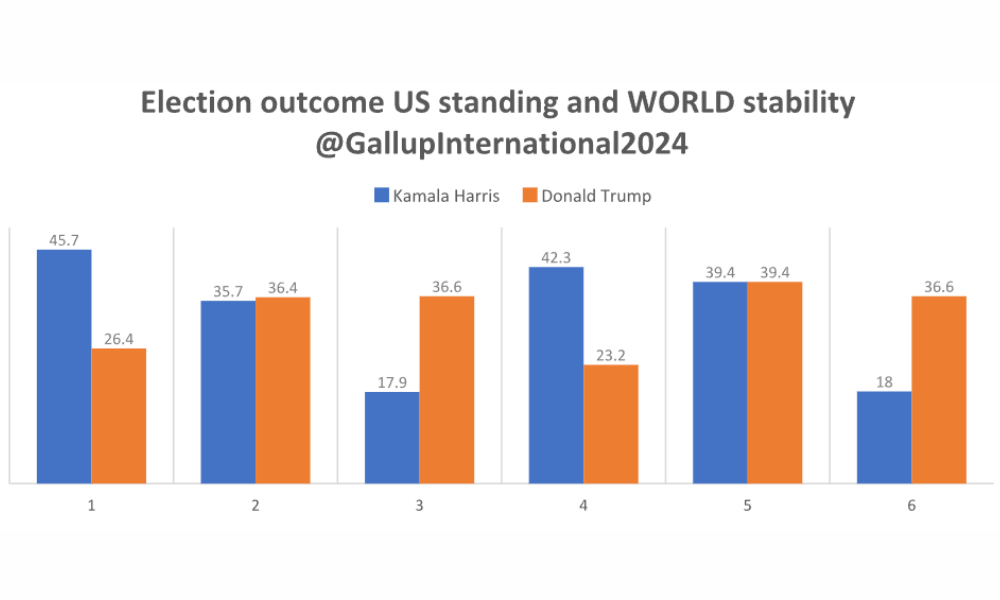
Nearly half of Malaysians (46 percent) believe that Harris would improve America’s standing, with slightly less (42 percent) believing she would improve global security.
Malaysians were more divided on Trump, with slightly over a third believing he would decrease US standing and be a threat to world stability.
The standing of America’s new president in Malaysia will heavily depend on whether it takes meaningful steps to find a sustainable solution to the conflict in Gaza.
An immediate ceasefire allowing humanitarian aid is urgently needed, along with the recognition of an independent and sovereign state of Palestine.
US involvement in the conflict clearly suggests this is extremely difficult to do for either candidate as the conflict in the Middle East is widening to other countries.
This will be harder if the outcome of the US presidential race is contested through protests and in the courts and America takes an inward direction.
Impacts on Malaysia
The election result will have far-reaching consequences for Malaysia beyond the sentiments around and developments in Gaza.
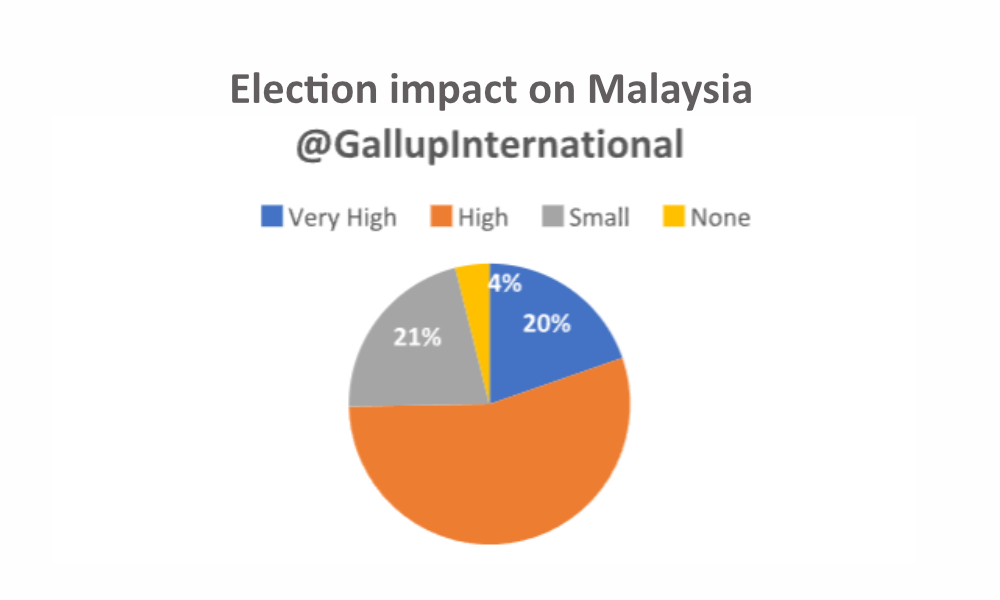
Polling suggests Malaysians recognise this, with three-quarters noting either “very high” or “high” impact.
My own view is that Malaysia is very much on the frontline of risks among countries in Southeast Asia.
For nearly four decades, Malaysia’s economy has been premised on connections to the US market and investments from US companies. Few appreciate that US businesses have been a major driver of recent growth in Malaysia, with RM200 billion in new investments since 2021 and the creation of 312,000 jobs in just the last three years.
If Trump wins, supply chains and operations will be at risk as it will not be “business as normal”. Recall that in a Trump 1.0, Malaysia was targeted for its trade deficits and “currency manipulation”.
Malaysia is now seen by many in Washington DC as “enabling” China to access technology and US markets without paying tariffs, as well as allowing Iran and Russia to evade sanctions.
Whether you agree or not with these measures, US policymakers are paying greater attention to Malaysia’s economy with an eye to using negative levers of forced labour bans, export controls, and other punitive tools that are being applied more widely.
Malaysia is also garnering negative attention on issues of transnational crime, corruption, and for its perceived embrace of both China and Russia.
These less favourable views cut across the political aisle in the US, including in Congress.
While Malaysia’s decision to join Brics as a partner country may be driven by a desire to access diverse markets, it is seen very differently among US (and European) policymakers who question whether it was necessary for Malaysian leaders to make repeated visits to Russia and join the stage with President Vladimir Putin.
Malaysia’s full membership in Brics still faces hurdles of acceptance from core member countries.
Testing times
Geopolitics is shifting and will shift further. There is a mythical view among Malaysian policymakers that US-China tensions will continue to benefit and bring in investments to Malaysia as it portrays itself as supposedly “neutral” and a “niche” economy.
This view is premised on the assumption that the past will repeat itself, but the reality is that a Trump 2.0 will not be the same as Trump 1.0. Similarly, a Harris administration will not be the same as the current administration of President Joe Biden.
Malaysia is under greater scrutiny. These issues come at a testing time for US-Malaysia relations, which one person close to the bilateral relationship describes as a “hard spot.”
While security and economic ties remain strong, managed by dialogue (with a dialogue of senior officials this month illustrative) and buttressed by shared interests, bilateral political ties are arguably at the worst they have been in decades. Negative sentiments simmer on both sides.
Views of the United States among Malaysians have fundamentally changed in recent years. Multiple surveys have shown that attitudes toward the US have become more negative, as more Malaysians have embraced alignment with China and do not see the country as a democratic model as they did in the past.
This is especially the case after Trump’s first presidency from 2016-2020 which saw an erosion of American democracy.
Prime Minister Anwar Ibrahim has opted to capitalise on anti-US sentiments to shore up his personal domestic support and engage in a broader political dealignment from the US.
In Anwar opting to engage in regular verbal attacks on the US, this has caused alienation and distancing in the relationship.
From Washington DC, Malaysia’s standing and importance among Southeast Asian countries has dropped, with more focus on Vietnam, Indonesia, and the Philippines.
Malaysia risks greater disengagement as trust has eroded, with emotions driving bilateral political relations rather than pragmatism.
Proactive planning
At a time of transition for the world, Malaysia has arguably not adequately positioned itself proactively to minimise risks to its economy and security vis-à-vis changes in the US, especially compared to other countries in the region, such as Vietnam (also facing considerable risks) and Singapore (less risks).
In Malaysia, there has been a considerable denial of the risks involved as a wait-and-see, wait-and-hope approach has been adopted.
Minimally, dialogues with the business community should be ratcheted up to build greater common ground to protect businesses and jobs in Malaysia. There needs to be more dialogue among partners in the region on possible steps ahead to reduce disruptions and secure supply chains.
Dialogue discussions need to move beyond senior officials – some of whom may be removed from their positions in a new administration, especially if Trump has his way of “cleaning out enemies” in the system.
While hope, optimism, and faith are essential, the world, including Malaysia, should brace for possible turbulence ahead. With America at one of the most painful times of its history, it is difficult to watch.
The best that can be done is to get prepared.
First published on Malaysiakini.